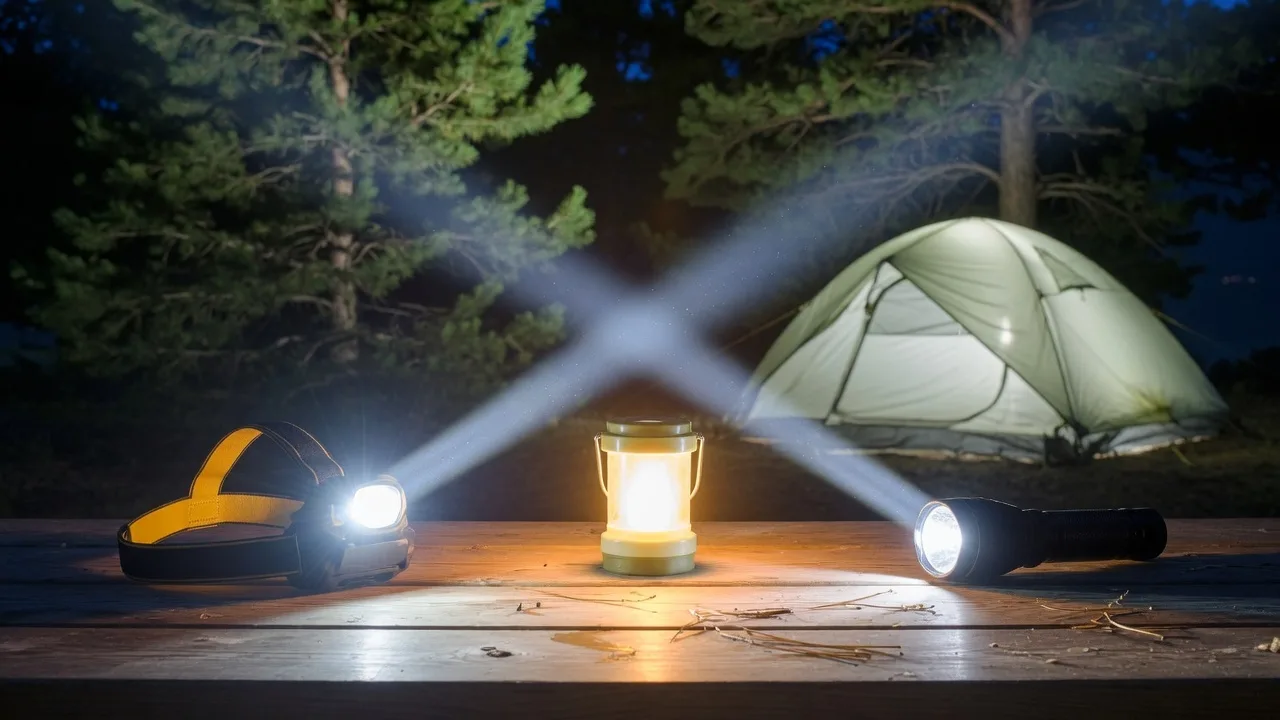
Best Torch for Camping: Headlamp vs Handheld vs Lantern
Quick answer: There isn’t one best camping torch, because camping asks lights to do three unrelated jobs. A headlamp for anything you do with your hands — cooking, pitching a tent, night hiking. A lantern for lighting a shared space so nobody is blinded by a beam. A handheld for looking at something far away, or for a serious blackout. Most campers are best served by a headlamp plus a lantern, and only add a handheld if they actually need distance. If you want specific models rather than a framework, jump to our best camping flashlights.
The reason “which torch is best for camping?” gets bad answers is that it’s usually answered with a lumen number. Lumens tell you how much light comes out; they tell you nothing about whether the light lands where you need it, whether your hands are free while it does, or whether it will still be running at 3 a.m.
The Three Jobs, and the Right Tool for Each
| Headlamp | Lantern | Handheld torch | |
|---|---|---|---|
| What it’s for | Tasks, hands-free, walking | Lighting a tent or table | Distance, searching, emergencies |
| Useful output | 200–500 lm (you’ll use 20–80) | 100–400 lm, diffused | 500–2,000 lm |
| Typical weight | 50–100 g | 150–400 g | 100–250 g |
| Runtime that matters | Low mode, 20–60 h | Mid mode, 10–40 h | High mode, 1.5–4 h |
| Beam shape | Wide flood, close | 360° diffuse | Focused, throwy |
| Weak point | Blinds whoever you look at | Useless outdoors at range | Occupies a hand |
Headlamp: the one to buy first
If you own exactly one camping light, own a headlamp. Cooking, washing up, finding something in a pack, guy-lining a tent in the wind, walking to the toilet block — every one of those wants both hands and a beam that follows your eyes.
What to look for:
- A genuine low mode. The number on the box is the high mode you’ll almost never use. Camp chores need 20–80 lumens, and the low mode is what determines whether the light lasts the weekend.
- A red mode. Red preserves your dark adaptation, so you can switch it off and still see the ground. It also doesn’t wreck the night vision of everyone else in the tent, and attracts noticeably fewer insects.
- A lock-out. Headlamps are the single worst offender for switching on inside a pack and arriving flat.
- A comfortable strap. Sounds trivial; it’s the thing that decides whether you actually wear it.
Specific models, and why camping and running want different ones, are in best headlamps for camping & running.
Lantern: what makes a camp feel civilised
A lantern isn’t a luxury item — it solves the problem headlamps create. Sit four people round a table wearing headlamps and everyone spends the evening being dazzled. A lantern throws diffuse light in all directions, so faces are lit and nobody is aiming anything at anybody.
Look for a hanging hook or a magnetic base, a warm colour temperature (3,000–4,000 K is far more pleasant than cold blue-white at close range), and a mid-mode runtime in the tens of hours. Many double as power banks, which is genuinely useful on a longer trip.
Handheld torch: only if you need reach
A handheld earns its place when you need to see something 50 metres away — checking a noise at the treeline, following a trail marker, finding the car park, signalling. For that, output and beam focus both matter, and this is where the 1,000-lumen numbers are actually meaningful.
If you’re carrying one anyway for everyday use, a compact pocket light does the job fine; see best EDC flashlights under $50. If distance is the whole point, long-range flashlights are a different category with different specs.
The Four Specs Worth Reading
1. Runtime on the mode you’ll actually use. Manufacturers quote runtime under the ANSI FL1 standard, which measures until output drops to 10% of initial — so a “4 hour” light may be dim for much of hour four. More importantly, high-mode runtime is nearly irrelevant to camping. Find the low- and mid-mode figures.
2. Battery type, decided by trip length and temperature. Rechargeable 18650 or built-in cells with USB-C charging are the default now, and if you carry a power bank they’re clearly the right call — see our USB-C flashlight guide. But for a week off-grid, or in cold weather, lights that take AA cells have a real advantage: you can carry spares, and lithium AAs work down to about −40 °C where alkalines die and rechargeables lose a large chunk of their capacity. Cold is the one situation where the old technology still wins.
3. Water rating, and be honest about it. IPX4 handles rain. IPX7 survives being dropped in a stream and fished out (1 m, 30 minutes). IPX8 goes further. For most camping, IPX4 is the floor and IPX7 is the sensible target — a light that dies the first wet night is worse than no light, because you stopped carrying a backup.
4. Beam shape over brightness. A wide flood at 200 lumens lights a campsite better than a tight 1,000-lumen spot, which just paints a bright circle on one tree. Match the beam to the job: flood for tasks, spot for distance. The spec that actually predicts reach is candela, not lumens — see lumens vs candela vs beam distance.
Lumens: How Many You Actually Need
Camping is where the lumen arms race is least useful. Realistic figures:
- Inside a tent: 10–50 lm. More than that is unpleasant.
- Cooking, camp chores: 50–150 lm.
- Walking a trail at night: 200–400 lm on a headlamp is plenty; the limit is beam width, not power.
- Searching, or seeing across a valley: 500–2,000 lm, and now beam distance matters more than lumens.
High output costs runtime roughly proportionally, and most lights step down after a few minutes on turbo to manage heat. The full explanation is in how many lumens should a flashlight have?.
The Setup Most Campers Should Buy
Car camping: a headlamp each, plus one rechargeable lantern for the table. Add a handheld if you camp somewhere with wildlife worth identifying at range.
Backpacking: one headlamp, and nothing else. Weight is the whole game — a 60 g headlamp with a red mode and a 40-hour low mode covers everything. Some campers hang the headlamp inside a translucent water bottle as an improvised lantern, which works better than it has any right to.
Family camping: a headlamp each including the kids (a light of their own dramatically reduces the number of times you get asked to find something), one or two lanterns, one handheld kept in the car.
Emergency and off-season: whatever you own should overlap with your home blackout kit. The same lights cover both jobs — see best flashlights for power outages.
Whatever the mix, follow the two-light rule: carry a backup, and don’t let both run on the same battery type. A single point of failure on a dark night in the woods is the one camping gear mistake that turns a nuisance into an actual problem.
And while you’re packing lights, pack fire. A butane lighter loses pressure in the cold (refillable n-butane ones below about 40 °F; isobutane disposables like BIC hold out to around 11 °F), which is exactly when you want it most — an arc lighter doesn’t have that problem.
FAQ
What is the best type of torch for camping? A headlamp, for most people. It’s the only light that leaves both hands free, which is what nearly every camp task requires. Add a lantern for shared light and a handheld only if you need distance.
How many lumens do I need for camping? Far fewer than the marketing implies. 20–80 lumens for camp chores, 200–400 for night walking, and 500+ only when you need to see a long way.
Are rechargeable or battery torches better for camping? Rechargeable for weekends and anywhere you can top up. AA-powered lights for long off-grid trips and cold weather, where you can carry lithium spares that work far below freezing.
What water rating do I need? IPX4 is the practical minimum for rain. IPX7 is the sensible target — it survives full immersion, which is what actually happens to a light dropped near a stream.
Do I need a red light mode? It’s one of the most useful features on a camping headlamp. It preserves your dark adaptation, doesn’t dazzle other people, and draws fewer insects.
Can I use my camping torch as a lantern? Roughly, yes — stand it beam-up under a translucent water bottle or a dry-bag and it diffuses surprisingly well. It’s the standard backpacker’s trick for avoiding a second light.